


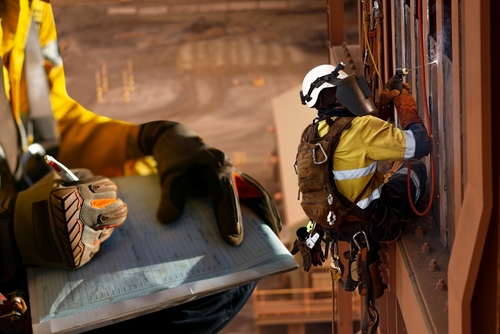
Preventing the Top 4 Construction Hazards
Construction is one of the most hazardous industries in the United States. Many injuries on construction sites are caused by falls, struck-by incidents, caught-in-between incidents and electrocutions. The following are basic safety tips for avoiding these hazards and remaining injury-free:
- Preventing Falls
- Wear and use fall arrest equipment.
- Cover and secure all floor openings and label floor opening covers.
- Use ladders and scaffolds safely.
- Preventing Struck-by Incidents
- Avoid positioning yourself between moving and fixed objects.
- Wear high-visibility clothing near equipment and vehicles so others can see you clearly.
- Preventing Caught-in-Between Hazards
- Avoid entering an unprotected trench or excavation 5 feet or deeper without an adequate protective system in place. Some trenches less than 5 feet deep may need a similar system.
- Make sure that a trench or excavation is protected by sloping, shoring, benching or a trench shield system.
- Preventing Electrocutions
- Locate and identify utilities before starting work for the day.
- Look for overhead power lines when operating any equipment.
- Maintain a safe distance from power lines and learn your area’s distance requirements.
- Do not operate portable electric tools unless they are grounded or double-insulated.
- Use ground-fault circuit interrupters for protection.
For more information, speak to your supervisor.
Selecting Safety Gloves for Work
There isn’t one universal glove that protects against every hazard on every job. As such, it’s critical to determine which pair is right for you and the work you are performing. Here are some essential aspects to consider when selecting gloves to protect your most important tool: your hands.
Fit
Measure your hand circumference around the palm or at the base of the fingers. The number of inches will determine your glove size.
Dexterity
Disposable thin-gauge gloves made from natural rubber latex (NRL), nitrile, neoprene or plastic PVC typically offer the most dexterity. Thin, disposable gloves allow for work with small parts, lab work, patient contact and food preparation. As thickness increases, gloves become more durable and protective but may prove less dexterous.
Protection From Biological Contaminants
Use disposable gloves, such as medical-grade exam gloves, when handling viral and bacterial agents.
Protection Against Chemicals
Use disposable nitrile gloves when handling oils and grease. They also protect against dry chemicals and other lab chemicals. These types of gloves can be layered to provide added protection.
Toughness
Wear cotton or leather gloves when handling abrasive or heavy objects. Gloves coated with NRL, PVC, nitrile, neoprene and polyurethane outwear regular cotton and leather gloves by 10 to 20 times. Gloves with coating offer the least amount of dexterity, so choose a pair with lighter-weight coatings or palm-coating or flat-dipped gloves.
Cut Resistance
If you need to protect your hands against sharp objects, choose gloves with a high level of cut resistance (Level 0=<200 grams to Level 5=3,500 grams).
Handling Oily or Slippery Objects
Wear sponge- or foam-coated gloves that allow you to have a solid grip on slippery objects. Oil is able to penetrate these types of gloves, making the objects easier to hold.
Chemical Hazards
Wear gloves coated in NRL, nitrile, neoprene or PVC when handling janitorial or sanitation products, fuels, grease and oils. Butyl or laminate gloves are ideal when handling ketones. You should wear neoprene when handling acids and caustic materials.